


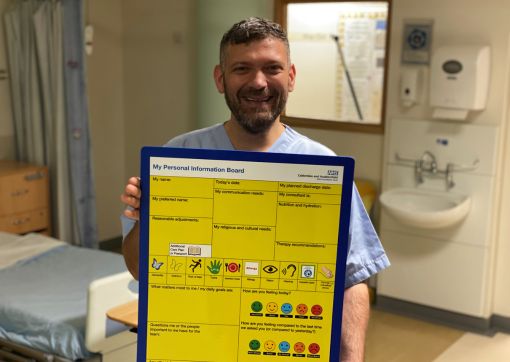
Over the next few weeks brand-new patient information boards are being installed in our inpatient areas, replacing the old white 'behind the bed' boards.
They have been co-created with colleagues, patients and carers to support patient-centred care and were a huge hit with colleagues during the pilot.
Newly qualified Nursing Associate, James Morley, tells us more about how the boards supported him and his colleagues in caring for patients in Coronary Care, one of the pilot wards.
He said: “As soon as I saw the new boards I realised we could have so more information to support the care we give. Things like eating habits, nutrition and hydration, allergies, falls and risks, to the things our patients enjoy or that they want to talk about (or not). The current behind the bed boards basically give the name of the patient, consultant and nurse, but there isn’t space for a lot more information.
“Using the board immediately gave me a much better rapport with my patients, which is really important, especially if you’ve just come onto shift. I could look at the patient’s board without necessarily having to look on a computer to find out their information. It’s especially important to be able to strike up a conversation with our dementia patients as an example to get to know more about the person behind the patient. Simple things like being able to write their preferred name will help so much.
“I truly believe we can give better patient-centred care with the new boards."
Other elements on the board include reasonable adjustments and where patients have a hospital passport, as well as the Martha’s Rule questions we ask patients each day, which act as a prompt to update our electronic patient records.
The boards can be moved with the patient too as they are secured by velcro, and they can be amended at any time.
Senior Nurse, Vicki Drummond, said: “We know that unpaid carers can’t always be by the bedside. Their feedback during the pilot was that they have much more confidence in the care we’re giving to their loved ones as they’ve been able to write everything that’s important on the board.
“It’s not for everybody. Patients who are only with us for a couple of days, or our younger patients, may not be as concerned with adding their information.
"It’s important for us to remember that use of the boards is always completely the patient’s choice.”