
What is involved?
A 30-minute outpatient appointment will be arranged for you. The test itself takes about ten minutes, and uses an EndoSign® device, whereby a small sponge collects cells from your oesophagus. These cells are then looked at in a laboratory to check for signs of abnormalities. You will receive the results within a few weeks.
Before your appointment
You should have nothing to eat or drink for 4 hours before your appointment.
Take your medication as normal, but only with a little water. Please bring a list of your medications to the appointment. If you are on blood thinners you will be given separate instructions from the capsule sponge team. If you have diabetes please have a light breakfast early morning, a minimum of 4 hours, before your appointment and take your usual medication.
At your appointment
When you attend your appointment, a healthcare practitioner will take a brief medical history, go through the test with you and answer any questions you may have.
The healthcare practitioner will then ask you to sign an online consent form agreeing to the test. We sometimes may also ask whether you are happy to be observed during the procedure. It is no problem if you decline.

The capsule is similar in size to a vitamin pill and contains a small sponge inside a vegan shell attached to a piece of strong, thin thread. The healthcare practitioner uses an applicator to place the capsule on the back of the tongue. You will be given water to drink and asked to swallow the capsule.
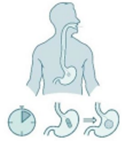
After swallowing, the capsule will stay in your stomach for 7 minutes until it dissolves, releasing a small soft sponge.

The healthcare practitioner will gently but swiftly remove the sponge by pulling on the thread. You may experience temporary discomfort as the sponge reaches your throat, but this only lasts a few seconds as the sponge is removed, it collects cells from the lining of your oesophagus (food pipe).
Visit www.endosign.com for more information and to watch a video or you can watch it below:
After your appointment
After the test, you can carry on with your day as normal. You may experience a mild sore throat after the test. Paracetamol and throat lozenges can help to soothe this.
Your cell sample will be sent to a laboratory and tested for signs of Barrett’s oesophagus, inflammation or cancerous changes. The results will be given to you either by telephone or letter. We expect this to take around 2-6 weeks following your procedure.
If your capsule sponge test shows your cells are normal, this indicates that there is no evidence of damage to the oesophagus, and you will continue with treatment, such as acid-suppressants for your symptoms.
If the capsule sponge test identifies any abnormal cells, this indicates that there is some damage to the oesophagus which will require further investigation with an endoscopy.
Are there possible side-effects?
- More than 20,000 people have had the test with no serious side-effects reported.
- Swallowing the capsule is not painful and most people have no problem doing so.
- You may have a mild sore throat after the test which might last up to 48 hours.
- There is a very small risk (less than 1 in 2,000) of the sponge becoming detached from the thread, or the healthcare practitioner is unable to remove it. If this happens you will have a same-day endoscopy to retrieve the sponge.
- There is a very small risk that you may have some bleeding; this is more likely if you are on blood thinning medications. If this happens, please call 111 for advice or attend A&E and let them know you have had a capsule sponge test. This is unlikely to need any intervention but if required an endoscopy could be performed to find and stop the bleeding. This has never been needed in more than 10 years of tests.
- Like all tests, the capsule sponge may not always find all abnormalities. On very rare occasions, a serious abnormality might not be identified. If you have any questions about this, please contact the clinic using the contact details on your referral letter.
Alternatives to capsule sponge
If you prefer to continue with endoscopy instead of having the capsule sponge, please let the team know your preference when they contact you by telephone, please note calls from the hospital may display as “no caller ID” or “unknown number”.
Information for patients on blood thinning medicines
If you are taking any blood thinning medications that may affect your clotting, you should have received specific instructions on what to do regarding these medications during the telephone call where your appointment was booked. If you have not received this information or have any questions, please contact the clinic using the details on your initial letter.